SECM Workshop @ ICSE 2017

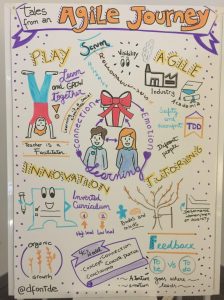
Art by Nayla Portas

I recently participated in this workshop. It started with a talk by my colleague and friend Diego Fontdevila: Tales from an Agile Journey: Designing Curricula from Millennials in Industry and Academia. While Diego was talking,  Nayla Portas took care of graphics facilitation, great work!

The rest of the morning was dedicated to present all the submitted papers and the afternoon was for debating following a fishbowl-like dynamic.

During the afternoon some students join the session to participate in the debate. I am not sure about the exact number of participants but I think we were around 15, including people from Argentina, Brazil, USA, Sweden, Uruguay, Chile, Rusia, Spain, Italy and China.
After the workshop some of the participants went to a near restaurant to share the dinner. It was the earliest dinner I had in my whole life,  I was eating meat at the 7 pm!

I want to thank Hakan and Cécile for organising this workshop. It was a really valuable activity, it was great to see people from so different contexts sharing their experiences.
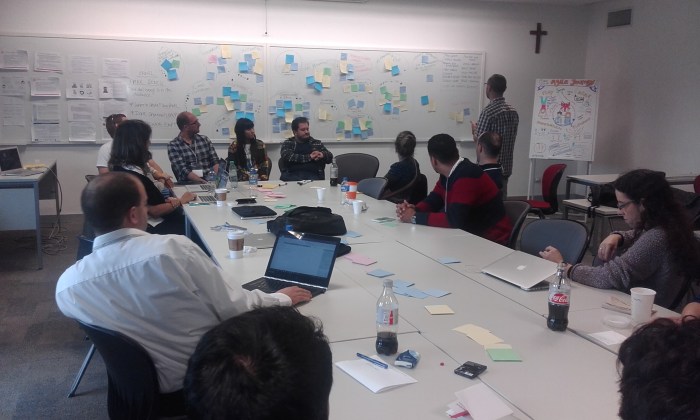
There are some more pictures of workshop in its website.
ICSE 2017, my notes from Technical Briefings

ICSE 2017, my notes from Technical Briefings

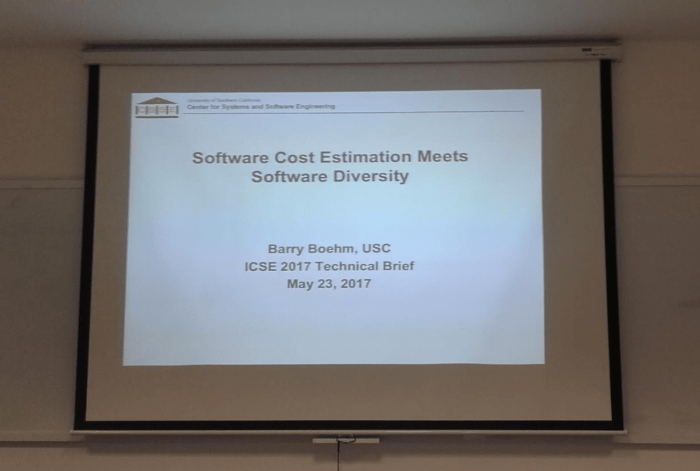
I recently had the chance to attend to this conference. It was organised in 3 parallel tracks with session of 90 minutes length. I started my journey in the session by Barry Boehm, yes that guy, the one that created COCOMO and wrote those classical books about software cost estimation. The title of the session was: Software cost estimation meets software diversity. The session was fine, the content was not innovative in my opinion but beyond that, it was incredible to see Barry, who is 82 years old, presenting it.

Next, I went to the session by Damian Tamburri that was called DevOps: Introducing Infrastructure as Code. The session started with a brief introduction to DevOps foundations and then it focused on the Infrastructure as Code practice by presenting an standard specification for defining infrastructure as code. I didn’t know about this spec, it is called Tosca and seems very promising. In a certain way this specification standardises some of the feature currently supported by Terraform.

In the afternoon I went to the session Analyzing Software Engineering Experiments: Everything You Always Wanted to Know but Were Afraid to Ask by Sira Vegas. I expected this session to be interactive, but it wasn’t, it was a lecture, where Sira shared several common mistakes in Software Engineering Experiments and also how to prevent/avoid them.

To close the journey I attended to the session Detecting and Quantifying Architectural Debt: Theory and Practice by Yuanfang Cai and Rick Kazman. It was really interesting, it was focused on how to measure the debt in terms of money because that is a simply way for business people to understand its relevance. After this motivation the authors presented an initiative they are involved. The slides of the session are available here.

All the sessions I attended had between 10 and 30 participants, which in my opinion was too few given the relevance of the speakers.

One thing I would change is the length of the session, 90 minutes for «lecture-like» session is too much in my opinion. So I would propose to do shorter sessions or make them more interactive. Beyond these details, it was a really valuable journey for me.